
The Buyer’s Mindset vs. The Investor’s Mindset: How to Evaluate Commercial Property?
Imagine buying a car without ever asking about its mileage. You’d check the color, the model, maybe even the price tag — but skip the one detail that tells you how much value is actually left in it. Sounds strange, right? Yet this is exactly what happens every day in commercial real estate investing.
The biggest mistake commercial property buyers make isn’t a bad location choice or an inflated price. It’s something far more fundamental: they think like buyers instead of investors. And that single mindset shift — from “buyer’s mindset vs. investor’s mindset” — is what separates a mediocre purchase from a genuinely profitable commercial property investment.
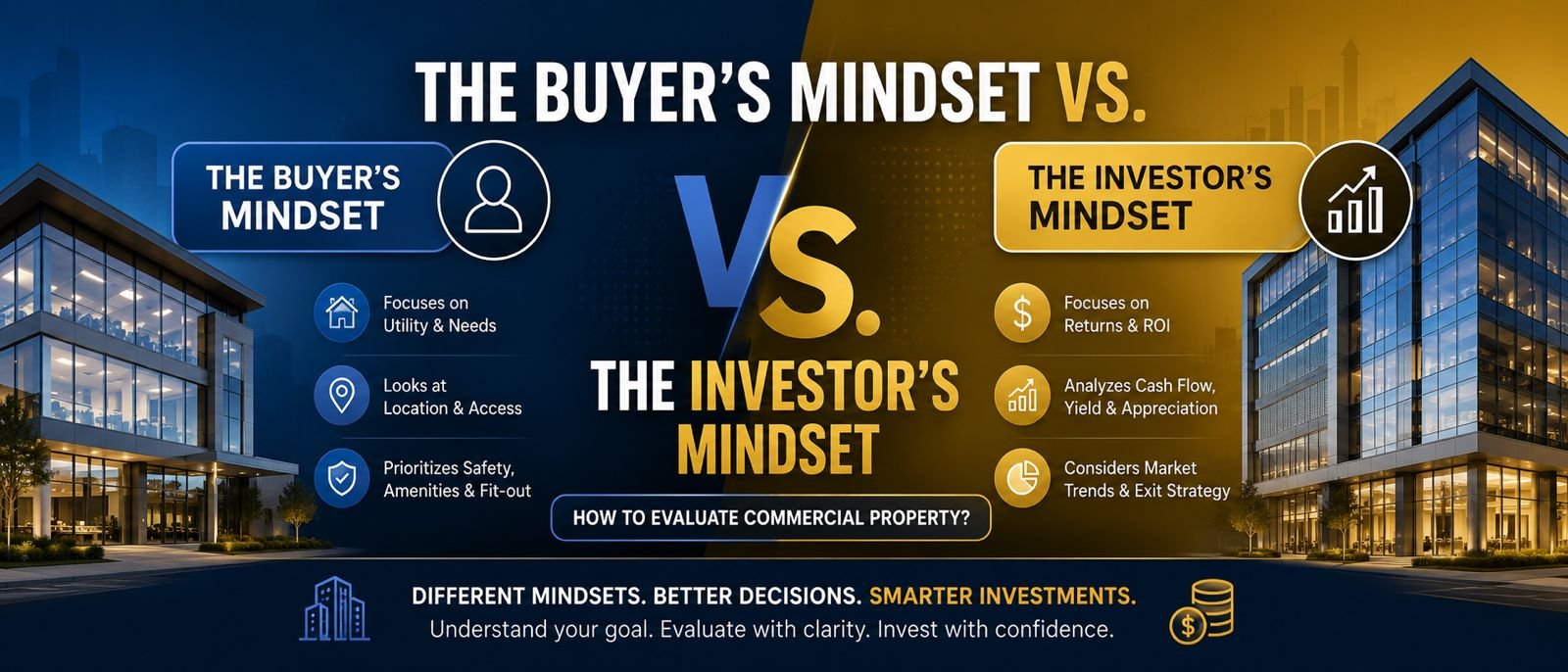
The Buyer’s Mindset: Why It Falls Short
Walk into any commercial property deal, and you’ll hear the same set of questions on repeat:
- What’s the location like?
- How big is the property?
- What’s the frontage?
- What’s the price?
These aren’t bad questions. In fact, they’re necessary. But they’re incomplete. They tell you what you’re buying — not what you’re actually going to get out of it. This is the buyer’s mindset in action: evaluating a property the way you’d evaluate any purchase, based on visible, surface-level features.
The problem is that commercial real estate isn’t a typical purchase. It’s not like buying furniture or even a home to live in. When you buy commercial property, you’re not just acquiring square footage — you’re acquiring a stream of future income. And if you never ask about that income, you’re essentially buying blind.
Premium Commercial Shop for Rent in Jaipur – Prime Locations Available
The Investor’s Mindset: Asking the Right Question
Here’s where the shift happens. Instead of asking “What’s the price?”, investors ask a completely different question:
“What kind of returns can this property generate over the next 5 to 10 years?”
That one question changes everything. It moves the conversation away from cost and toward value. It forces you to think about tenants, rental demand, appreciation trends, occupancy rates, and long-term cash flow — not just the number on the listing.
This is the essence of the buyer’s mindset vs. investor’s mindset debate. A buyer asks, “What am I paying?” An investor asks, “What am I earning?” A buyer evaluates cost. An investor evaluates potential.
Successful investors in commercial real estate understand a simple truth: you are not just buying square feet — you are buying future cash flow. Every commercial property is essentially an income-generating asset, and the smartest investors treat it that way from day one.
Why Revenue Sharing Leases Are the Future for Retail in Rajasthan
Why This Mindset Shift Matters So Much
Let’s go back to the car analogy. A car with low mileage but a slightly higher price is often the smarter buy than a cheaper car that’s been driven into the ground. The same logic applies to commercial property investment.
A property with a lower price tag but poor rental demand, weak tenant quality, or a declining micro-market could end up being a far worse investment than a slightly more expensive property in a high-growth commercial corridor with strong occupancy potential.
This is why comparing prices alone is a flawed strategy. Instead, investors should be comparing:
- Rental yield potential — What kind of monthly or annual income can this property realistically generate?
- Appreciation trajectory — Is the area growing, stagnant, or declining?
- Tenant demand — Are businesses actively seeking space in this location?
- Exit potential — If you needed to sell in 5–10 years, how liquid would this asset be?
- Risk factors — Vacancy risk, maintenance costs, regulatory changes, and market cycles.
None of these show up on a basic price comparison. They only surface when you start thinking like an investor.
How to Practically Apply the Investor’s Mindset
If you’re evaluating a commercial property right now, here’s a simple framework to shift from buyer thinking to investor thinking:
- Start with the end goal. Are you looking for steady rental income, long-term appreciation, or both?
- Project the cash flow. Estimate realistic rental income and subtract expected expenses — maintenance, taxes, and vacancy periods.
- Study the micro-market. Look at commercial activity, footfall, upcoming infrastructure, and business growth in that specific area — not just the city at large.
- Compare potential, not just price. Two properties priced similarly can have vastly different return profiles. Always run the numbers before deciding.
- Think in years, not months. Commercial real estate investing rewards patience. A 5–10 year outlook reveals value that a snapshot price comparison never will.
New Leasing Models: From Long‑Term Lock‑Ins to Revenue‑Sharing
Conclusion
The difference between a good commercial real estate decision and a costly mistake often comes down to one thing: mindset. Buyers ask what something costs. Investors ask what it can become. Before you invest in commercial real estate, don’t just compare prices — compare possibilities. Because the right investment isn’t always the cheapest one on the table. It’s the one that creates the most value over time.
If you’re serious about making smarter, more informed commercial property investment decisions, start asking the questions investors ask — not just the ones buyers default to. That shift alone could be the difference between an average purchase and an exceptional one.
Frequently Asked Questions (FAQs)
1. What is the main difference between a buyer’s mindset and an investor’s mindset in commercial real estate?
A buyer’s mindset focuses on surface-level factors like price, size, and location, while an investor’s mindset focuses on long-term returns, cash flow potential, and overall value creation over a 5–10 year period.
2. Why is asking about price alone not enough when evaluating commercial property?
Price only tells you the upfront cost, not the income or appreciation potential of the property. Two properties with similar prices can have very different return profiles depending on location, tenant demand, and market growth.
3. What does “buying future cash flow” mean in commercial real estate investing?
It means that when you purchase a commercial property, you’re essentially buying the right to future rental income and potential appreciation, not just the physical square footage of the building.
4. How do I estimate the potential returns of a commercial property?
Start by projecting realistic rental income based on current market rates, subtract expected expenses like maintenance and taxes, and factor in vacancy periods. Compare this against the purchase price to estimate your potential yield.
5. What factors should I compare besides price when investing in commercial property?
Look at rental yield potential, area appreciation trends, tenant demand, exit liquidity, and risk factors such as vacancy rates and regulatory changes in that specific micro-market.
6. Is a cheaper commercial property always a better investment?
Not necessarily. A lower-priced property in a declining or low-demand area can underperform compared to a slightly more expensive property in a high-growth commercial corridor with strong tenant demand.
7. How important is location in commercial real estate investment decisions?
Location remains important, but it should be evaluated in terms of growth potential and business demand, not just visibility or frontage. A great location with weak rental demand still won’t generate strong returns.
8. What time horizon should I use when evaluating a commercial property investment?
Most experienced investors evaluate commercial property over a 5 to 10 year horizon, since real estate value and rental income potential typically play out over the medium to long term.
9. What are common mistakes first-time commercial property buyers make?
First-time buyers often focus only on price, size, and frontage while ignoring critical factors like projected cash flow, tenant demand, and long-term market trends — leading to underperforming investments.
10. How can I shift from a buyer’s mindset to an investor’s mindset when evaluating property?
Start by asking what returns the property can generate over the next several years instead of just what it costs. Build a habit of projecting cash flow, studying the micro-market, and comparing potential value rather than just comparing prices.
Thanks for Reading!
Experts and Innovators for Your Real Estate Success
Connect with our professional real estate specialists to find the ideal commercial space and investment opportunities. Let us understand your business goals and provide strategic solutions, unlocking your growth potential in the real estate market.
Contact us today for further information